What Is a Seller Note? How It Works, Terms, and SBA Rules

Rachel Horner
⋅
9 min read
A seller note is a portion of a business’s purchase price that the seller agrees to let the buyer pay over time, rather than collecting the full amount at closing.
For example, a buyer agrees to pay $3.2 million for a business, but their bank will only lend $1.95 million. The buyer may not have enough cash to cover the remaining amount. If the seller agrees to finance $500,000 of the purchase price, the buyer can pay that amount back over time according to the terms of the note, helping bridge the financing gap.
Seller notes are common in SBA-financed acquisitions, where they can help buyers and sellers structure a deal that works for both sides. But the terms matter, including the interest rate, repayment schedule, and whether the note can count toward the buyer’s required equity injection.
Below, we explain what a seller note is, how it works, and what buyers and sellers should know when using one to finance a business acquisition.
What Is a Seller Note?
A seller note is a loan the seller of a business makes to the buyer to cover part of the purchase price. Instead of receiving the full price in cash at closing, the seller gets a portion later, plus interest, under a signed promissory note. The buyer repays the seller over time, usually from the business's own cash flow.
You'll also hear it called seller financing, a seller carryback, a seller carry note, owner financing, or a vendor note. They all describe the same basic idea: the seller acts as a lender for part of the deal.
Note: A seller note is not part of your cash price. It's a loan to the person buying your company, with the same risks any lender takes. That's why the terms matter as much as the headline number.
How a Seller Note Works
At closing, the buyer pays most of the price with cash and a bank loan. The seller "carries" the rest as a note. The buyer then makes payments to the seller on an agreed schedule, much like paying off any other loan.
A seller note does four specific jobs in a deal:
It bridges the gap between what the bank will lend and the purchase price.
It signals confidence. A seller willing to get paid over time is telling the buyer, and the bank, that they believe in the business after the keys change hands.
It shifts debt off the bank's loan. Moving part of the price into seller paper keeps the bank loan smaller, which helps the business pass the lender's cash flow test.
It can reduce the buyer's cash at closing. When placed on full standby, a seller note can count toward the buyer's down payment on an SBA loan.
Notice what's missing from that list: price. Two deals at the same price can be financed in completely different ways. The real question is how much of that price the bank carries, and on what terms the seller carries the rest.
A Quick Example
Take a business with a $2.2 million total project cost, financed with an SBA 7(a) loan that requires a 10% equity injection ($220,000). Here are three ways to build the same deal:
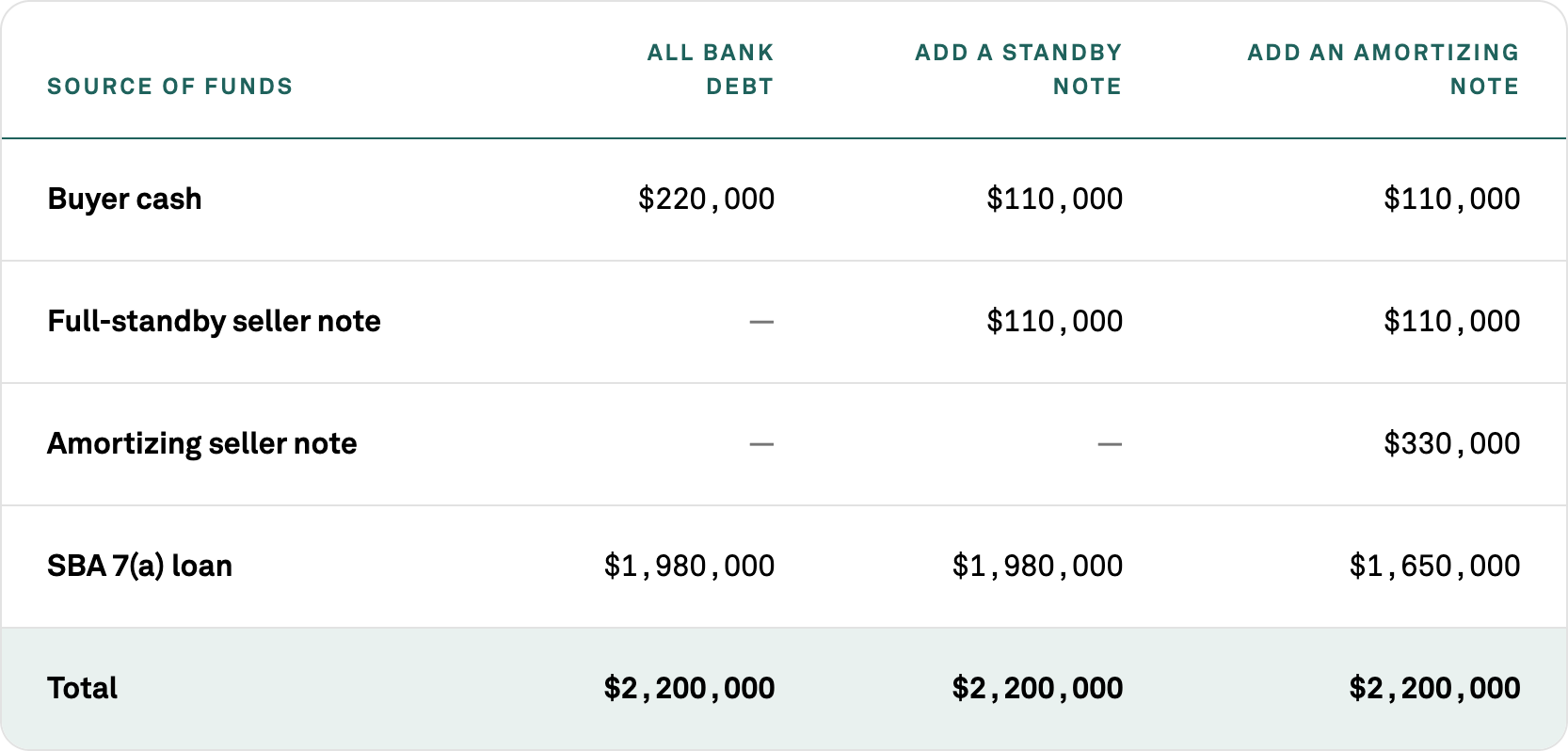
All bank debt. The buyer funds the full $220,000 injection in cash, and the bank lends $1.98 million. It's the cleanest to underwrite and the most cash out of pocket.
Add a full-standby note. A seller note on full standby covers half the injection, cutting the buyer's cash at closing in half. The bank still lends $1.98 million, so the coverage test doesn't change.
Add an amortizing note. A separate $330,000 seller note (15% of the price) takes part of the price off the bank's plate. The SBA loan drops to $1.65 million. If that note has interest-only early years, the business has a much easier time clearing the lender's coverage minimum.
Every lender models this a little differently, so treat these figures as a teaching example.
Key Seller Note Terms
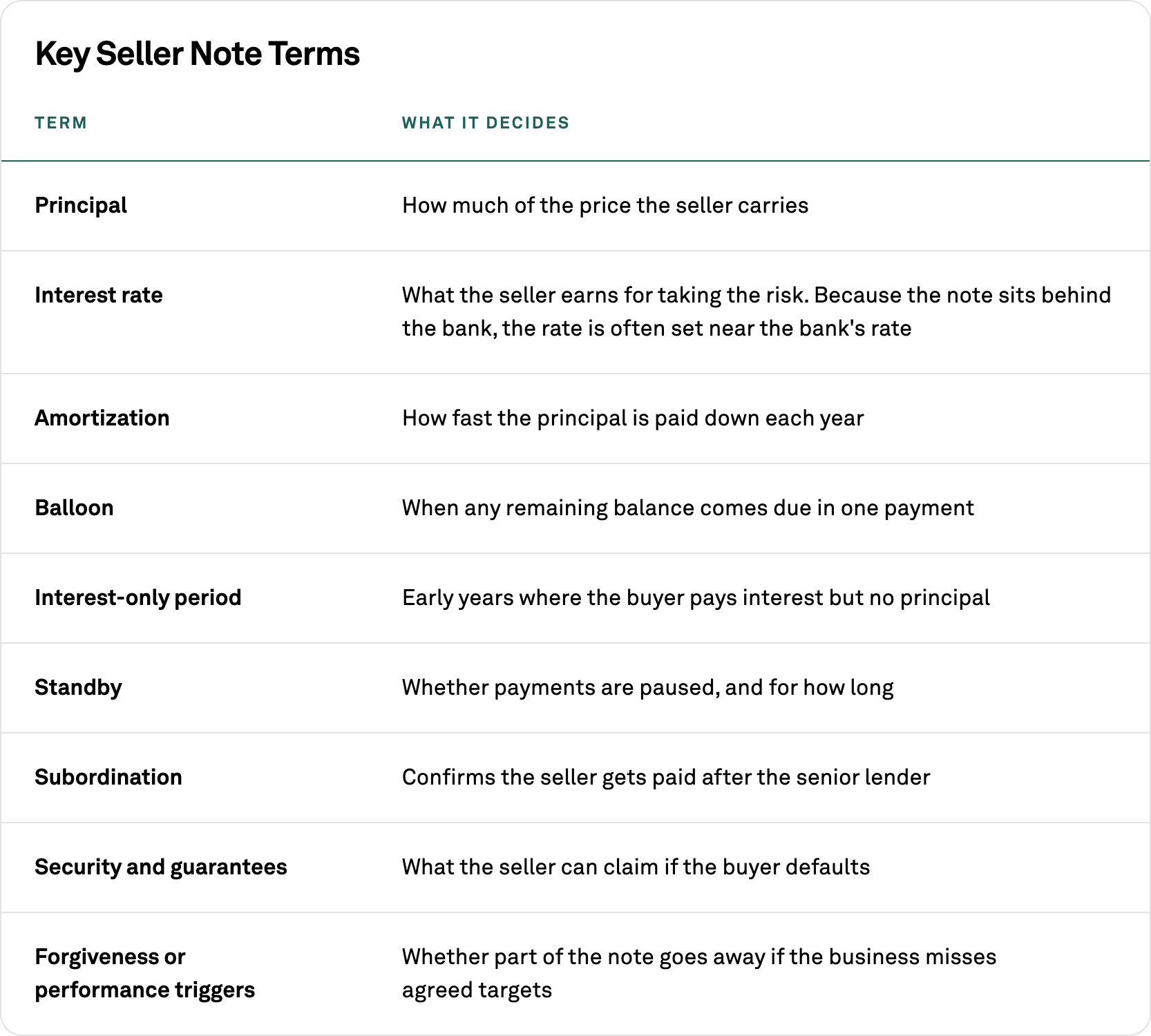
There is no standard seller note. Every term is negotiated between buyer and seller, and the lender should be in the conversation early so the payments fit its cash flow requirements. These are the terms that matter most:
Why Amortization Is the Hidden Lever
When you buy a business without real estate, the SBA 7(a) loan is amortized over 10 years. That sets the pace for the senior debt.
The trap is failing to match that pace on the seller note. Agree to a 5-year amortization on the seller note, and you're repaying the seller at roughly twice the speed of the bank. That causes two problems:
Optics. SBA lenders don't love seeing the seller paid back twice as fast as the bank. It looks like the seller is being made whole ahead of the senior lender.
Coverage. Faster principal payments mean a bigger annual debt service bill. That pushes your debt service coverage ratio (DSCR) down right when you need it to clear the lender's 1.25x minimum.
To fix this, stretch the seller note's amortization to match the 10-year SBA loan, or get as close as you can. If the seller wants their money sooner, add a balloon payment to shorten the actual payoff date. Matching amortization keeps annual payments low, and the balloon respects the seller's timeline without crushing the buyer's first few years.
Seller Notes and SBA Loans: Does Your Note Count?
If the buyer is using an SBA 7(a) loan, one word decides how the seller note is treated: standby. There's a big difference between the two kinds.
Full standby for the life of the loan. The seller receives no principal or interest payments until the SBA loan is repaid. This is the only kind of seller note that can count toward the buyer's 10% equity injection, and it can cover no more than half of the required injection. The rest must be the buyer's own cash.
Short standby (for example, 24 months). Payments pause for a set period, then begin. This helps the buyer's cash flow during the transition years. It does not count toward the equity injection, and the bank includes the note in its coverage test once payments start.
The old rule, where a note with 24 months of no payments could count toward the down payment, ended when SBA updated its lending rules in June 2025 (SOP 50 10 8). The October 1, 2026 update (SOP 50 10 8.1) keeps the same limit: standby seller debt, other standby debt, and minority investors combined can provide no more than half of the required injection.
Standby lowers the cash you need at closing. It doesn't fix weak cash flow, because lenders test debt service after the standby period ends.
Always Required: SBA Form 155
For any seller note in an SBA-financed acquisition, the seller must sign SBA Form 155, the Standby Creditor's Agreement. It applies whether the note is on full standby or not, because every seller note sits behind the SBA loan, and Form 155 documents that.
Get the seller comfortable with it early, ideally at the letter of intent (LOI) stage. It should never be a surprise at the closing table.
How to Negotiate a Seller Note
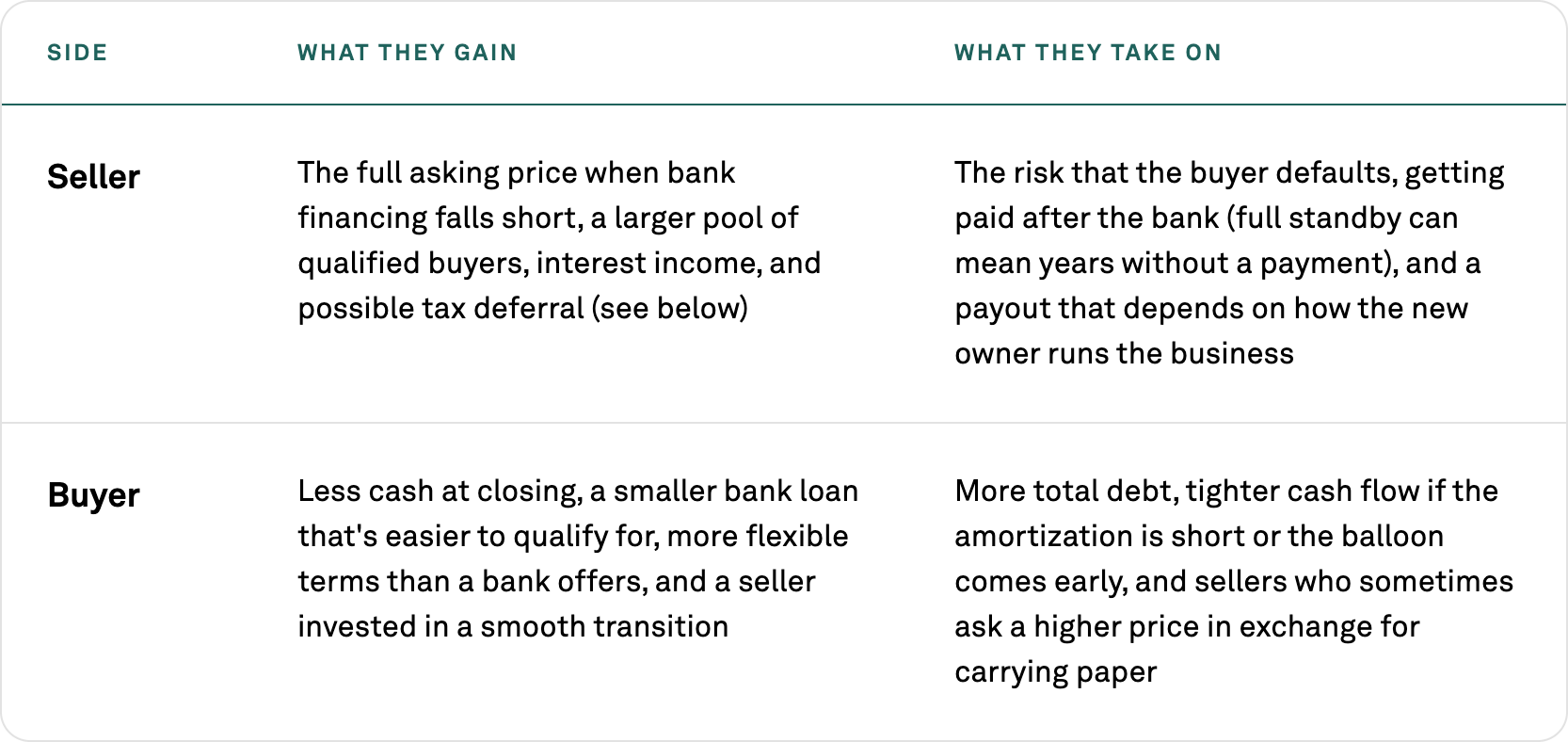
A good negotiation starts with knowing what each side gains from a seller note, and what each side takes on.
Whether you're buying or selling, a few habits prevent most late-stage surprises:
Bring the lender in early. The bank's coverage test sets the limits on what seller paper can look like.
Put the seller note terms in the LOI. Amount, rate, amortization, standby, and any forgiveness triggers belong there, along with agreement to sign SBA Form 155.
Match amortization to the bank loan. Use a balloon if the seller wants a shorter payoff.
Use interest-only early years to protect cash flow while the new owner gets up to speed.
Tie any performance trigger to verifiable numbers, not forecasts.
Sellers, vet the buyer like a lender would. Review their experience, credit, and plan for the business.
Tax Considerations
Because a seller note pays you over time, the sale may qualify for installment sale treatment. That can let you recognize part of your gain as payments come in rather than all at once in the year of the sale. Not every asset qualifies, and interest you receive is taxed as ordinary income. Talk to a tax advisor before you agree to terms. This article isn't tax or legal advice.
Final Thoughts
A seller note is a loan from the seller to the buyer, but in practice it's a structuring tool. The right mix of standby paper, interest-only years, matched amortization, and performance terms can close a deal at full price that would otherwise fall apart. The price stays the same. The structure decides whether the deal works.
That starts with knowing what your business is worth and how a buyer's lender will view its cash flow. Baton's free valuations are built on real comparable transactions, so you can walk into negotiations knowing which levers you have.
Seller Note FAQs
What Is the Purpose of a Seller Note?
A seller note covers the gap between the purchase price and what the buyer can pay with cash and bank financing. It also shows the seller's confidence in the business and can lower the buyer's cash at closing.
Is a Seller Note Considered Debt?
Yes. A seller note is debt owed by the buyer (or the acquired business) to the seller. In an SBA deal, it's subordinate to the bank loan, and lenders include it in their coverage test once payments begin. A note on full standby for the life of the SBA loan can count toward the buyer's equity injection.
Can You Give an Example of a Seller Note?
On a $2.2 million project with an SBA loan, a buyer might put in $110,000 in cash, the seller might carry a $110,000 full-standby note, and the bank might lend $1.98 million. Adding a $330,000 amortizing seller note would reduce the bank loan to $1.65 million.
What Is the Typical Interest Rate for a Seller Note?
There's no fixed rate; it's negotiated. Because a seller note sits behind the bank, it's often priced near the bank's rate. On a full-standby note, interest may accrue, but nothing is paid until the SBA loan is repaid.
What Is a Full Standby Seller Note?
A full standby seller note pays the seller no principal or interest until the SBA loan is fully repaid. Under current SBA rules, it's the only kind of seller note that can count toward the buyer's 10% equity injection, up to half of the required amount.