What Is a Search Fund? How They Work, What They Buy, and What It Means for Owners

Rachel Horner
⋅
11 min read
When a business owner starts thinking about selling, the buyer they picture is often another company, an investor, or an individual looking to become an owner. But there's another type of buyer worth understanding: the searcher.
A searcher raises capital to find a small business, acquire it, and take over as its CEO. Unlike a buyer who may simply want an investment, a searcher is betting on their ability to operate and grow the business themselves.
That model is gaining momentum. New search funds launched at historically high levels in 2024 and 2025, according to Stanford, meaning more searchers are entering the market and more owners are likely to encounter them as potential buyers.
If you're considering a sale, it helps to understand who these buyers are and what they're looking for. We'll start with how search funds work and the different models behind them, then look at the owner's side of the deal: what a searcher offer can look like, how the process differs from other types of acquisitions, and how to assess whether you're dealing with a serious buyer.
What Is a Search Fund?
A search fund provides capital for an entrepreneur, known as a “searcher,” to find and acquire a privately held company. The searcher raises money from investors, finds a business to acquire, and then takes over as CEO. Private equity firms typically take a different approach, acquiring multiple companies and hiring management teams to run them.
Once considered a traditional business-school path, it has become an increasingly popular option for a much broader group of entrepreneurs. For instance, Stanford’s 2026 Search Fund Study now covers more than 850 funds in the U.S. and Canada.
For those who want to run a business but don't want to build one from scratch, an acquisition offers a chance to step into an established company, take on the responsibility of running it, and shape what comes next. For a business owner who may be ready to retire, step back, or simply ensure the business continues under new ownership, a searcher can bring a fresh perspective and renewed energy. Their goal is not simply to take over the business, but to operate it, grow it, and create long-term value.
How a Search Fund Works
A traditional search fund moves through four stages. From the owner's seat, you'll usually meet a searcher somewhere in stage two.
Raising search capital. The searcher raises a modest amount from a group of investors to cover salary and expenses while they look for a company. In exchange, those investors usually get the first right to fund the eventual acquisition.
The search. The searcher reviews hundreds of businesses, calls owners directly, and works with brokers and marketplaces. This is the long part. Stanford's 2026 study puts the median time from launch to acquisition at about 20 months, and roughly half of recent searchers never buy a company at all.
The acquisition. Once an owner and searcher agree on terms, the searcher goes back to investors for the equity to buy the business, typically paired with bank debt or a US Small Business Administration (SBA) loan and, often, seller financing or seller equity.
Operating and exit. The searcher becomes CEO and runs the company, usually for several years. The searcher earns a meaningful equity stake (often up to about 25%) that vests over time and with performance. The business is eventually sold or recapitalized, or, increasingly, held long term.
The four stages explain a lot about how searchers behave. They are working against the clock in stage two, they need investor and lender sign-off in stage three, and they plan to live with your business for years in stage four. Those pressures can shape what they prioritize at the negotiating table.
Types of Search Funds
“Search fund” is a broad term for entrepreneurs who raise capital to buy and run a small business. But searchers can follow several different models, and the distinction matters to sellers because it can change who funds the acquisition.
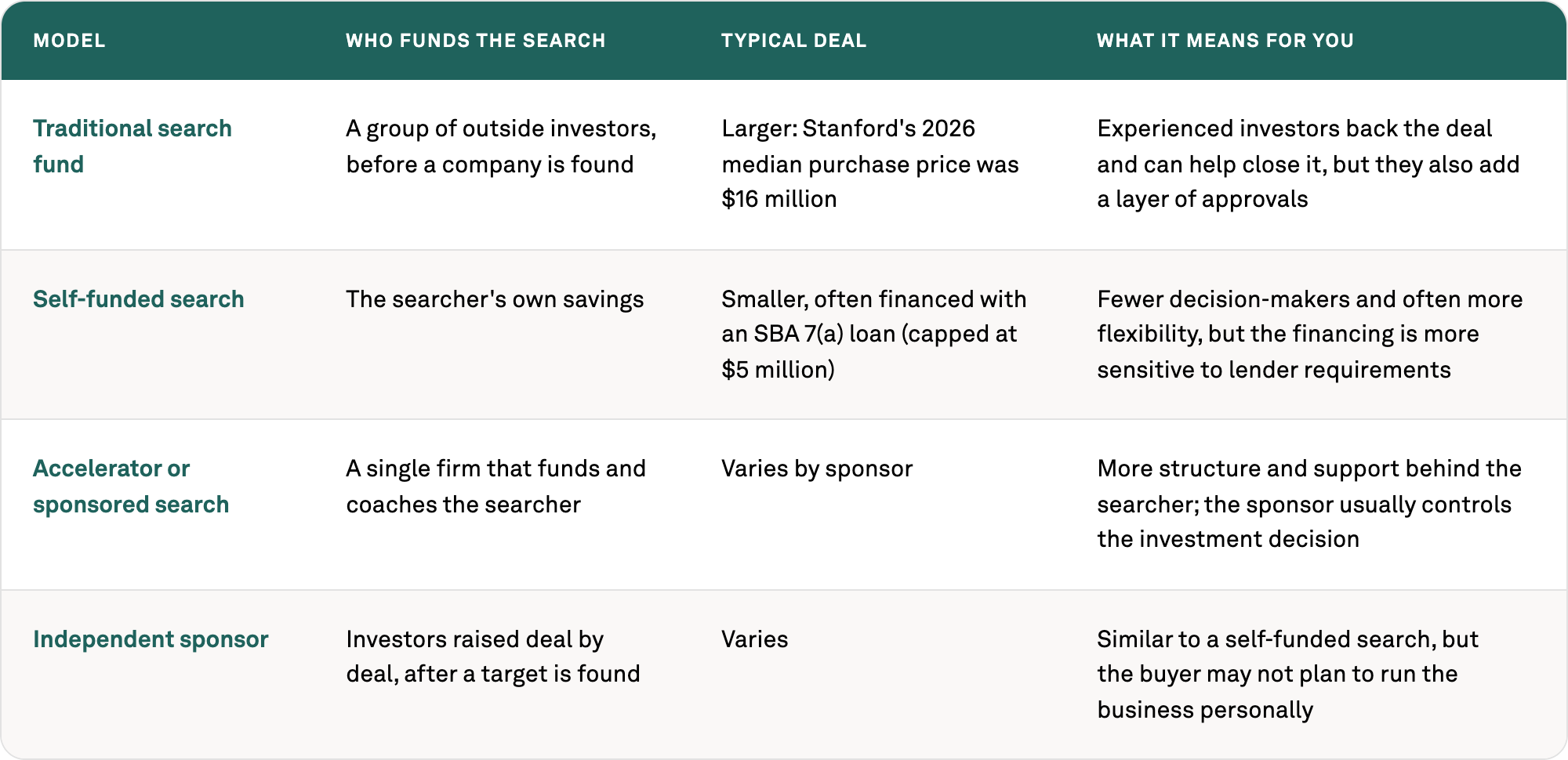
What Kinds of Businesses Do Search Funds Buy?
Searchers look for businesses that are profitable, predictable, and positioned for a new owner to take the reins. They tend to favor companies with healthy margins, repeat or recurring revenue, and operations that don't depend entirely on the current owner.
Traditional search funds tend to target larger companies. Stanford's 2026 study found that the median company acquired by a traditional search fund had about $8.1 million in revenue, $2.5 million in EBITDA, and roughly 30 employees.
Self-funded searchers often target smaller businesses. A 2023 study of 279 self-funded searchers found that 55% of acquired companies had less than $5 million in revenue, while the most common EBITDA ranges targeted during the search were $750,000 to $2 million.
The financing structure also makes smaller acquisitions possible. Among self-funded searchers who completed an acquisition, 58% used an SBA 7(a) loan and 45% used seller financing.
What Makes Your Business Attractive to a Search Fund?
The email usually arrives on a Tuesday. It's polite, a little formal, and signed by someone in their early thirties with an MBA. They admire what you've built. They'd like to buy your company. And, unusually, they want to run it themselves.
If you've received a message like this, you've met a searcher.
This half of the guide is for you: why searchers are interested, what the selling process looks like, how searchers compare to other buyers, and how to tell a serious one from a long shot.
A searcher is buying a job as much as a company, and they're financing it with debt. So they want cash flow that's steady, documented, and doesn't depend on you personally. Here's what they screen for, why it matters to them, and how you can show it:
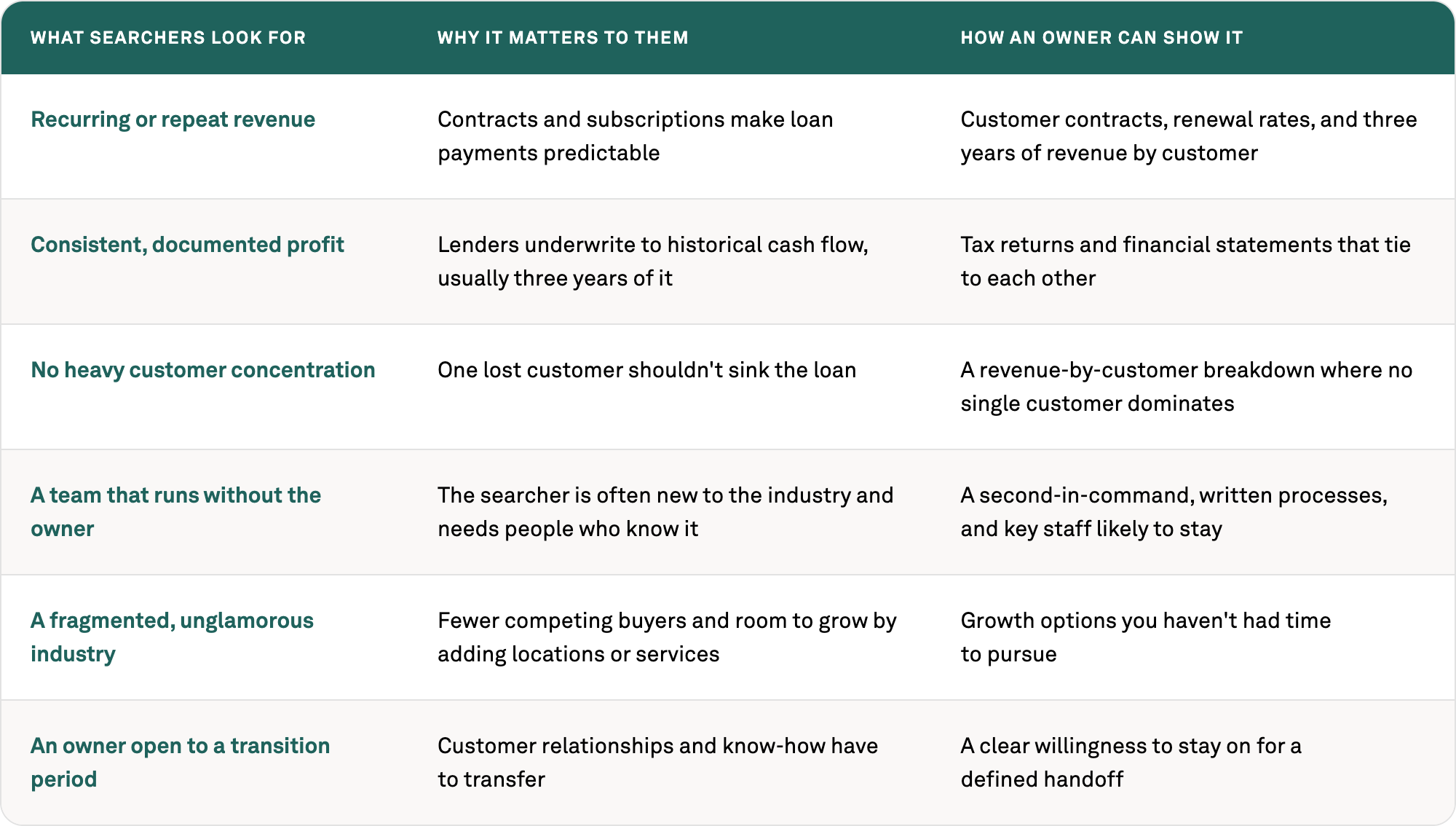
What to Expect When Selling to a Searcher
Selling to a searcher feels different from selling to a private equity firm or a competitor. It's personal. The person across the table is interviewing for your job, and you're deciding whether to hand them your life's work.
Here's how the process tends to unfold.
1. First Contact
Most owners hear from searchers before they've decided to sell, and that's by design. Searchers prefer off-market businesses, where they can make an offer without bidding against other buyers. Dealmakers call this a proprietary deal. It's also why searchers send so much cold outreach, so a single letter or email doesn't mean much on its own.
A proprietary deal changes the dynamics for both the buyer and seller. It's quiet and confidential, but with no competing offers to compare against, the only check on price is knowing what your business is worth.
2. Letter of Intent
If the fit is there, the searcher sends a letter of intent (LOI) laying out price and structure. Searcher offers often include more than cash at close: a seller note (you finance part of the price and get paid back over time), rolled equity (you keep a stake in the business), or an earnout. Stanford found that 63% of first search fund acquisitions included equity for the seller.
How a Searcher Offer Is Structured: A Worked Example
The headline price in a searcher's LOI is rarely all cash. Here's a simplified, hypothetical offer for a business priced at $12 million:
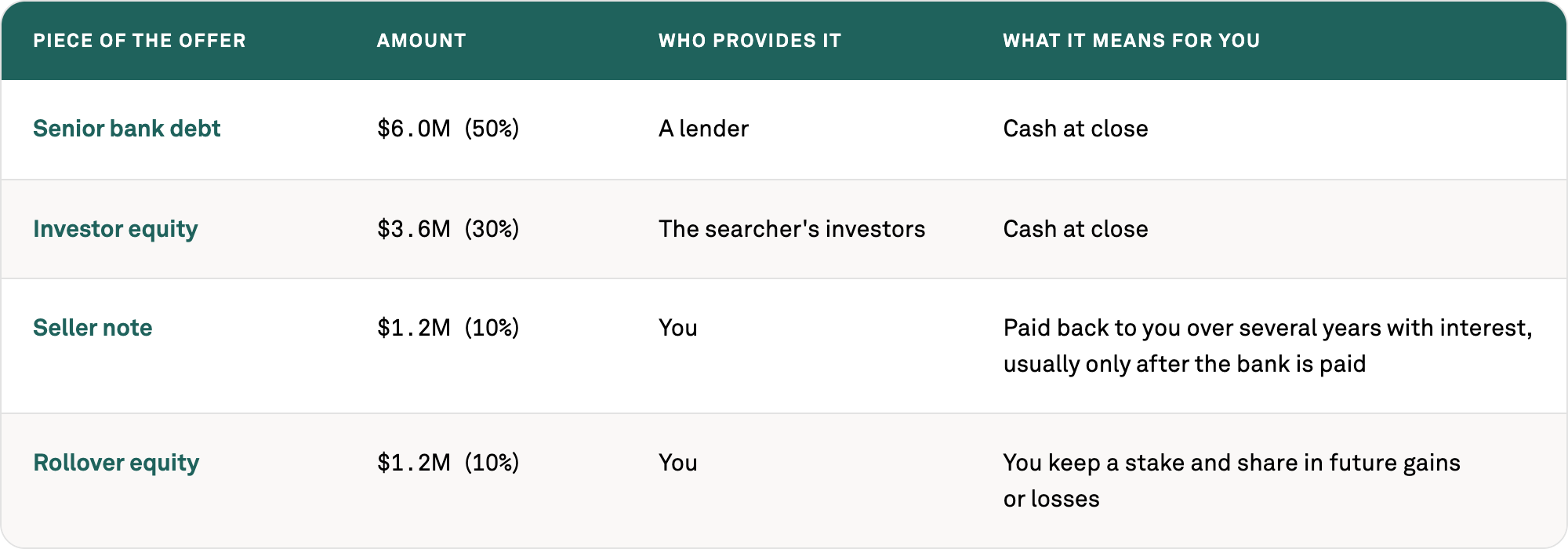
In this example, you'd receive $9.6 million (80%) at closing. The other $2.4 million depends on how the business performs after you hand it over.
Some offers add an earnout: an extra payment, say $1 million, if the business hits a revenue or profit target within a set period. Earnouts can close a gap on price, but you're betting on results you no longer control.
Before comparing offers, ask four questions:
How much of the price is cash at closing?
What are the seller note's interest rate, term, and ranking behind the bank?
Does your rolled equity get the same terms as the investors' equity?
If there's an earnout, how is the target defined, and who measures it?
3. Diligence
In diligence, the details of the deal come together. A searcher’s investors and lender will closely review the business’s financials, often with a third-party quality of earnings review. Sellers who provide clean financials and a well-organized data room can help keep diligence moving and avoid surprises that could change the terms or put the deal at risk.
Heads up: the lender and the investors may ask overlapping questions. It can feel repetitive, but each of them has to sign off before the searcher can close.
4. The Handoff
Expect to stay involved after closing, often for several months to a year, to help the new CEO build relationships with customers, suppliers, and employees. Because searchers plan to run the business themselves, they often have a strong incentive to preserve those relationships and understand how the business operates.
Spell out the transition terms in the purchase agreement rather than leaving them to a handshake. Define how long you’ll stay, how many hours you’ll work each week, whether you’ll receive compensation, and what happens if the arrangement isn’t working. Owners who roll equity into the deal may also stay on as advisors or take a board seat, giving them a continued role in the business after closing.
Search Fund vs. Private Equity vs. Strategic Buyer
The biggest difference in each model is who runs your business the day after closing. A searcher moves in as CEO. A private equity (PE) firm installs or keeps a management team. A strategic buyer, usually a competitor or larger company in your industry, folds you into its own operations.
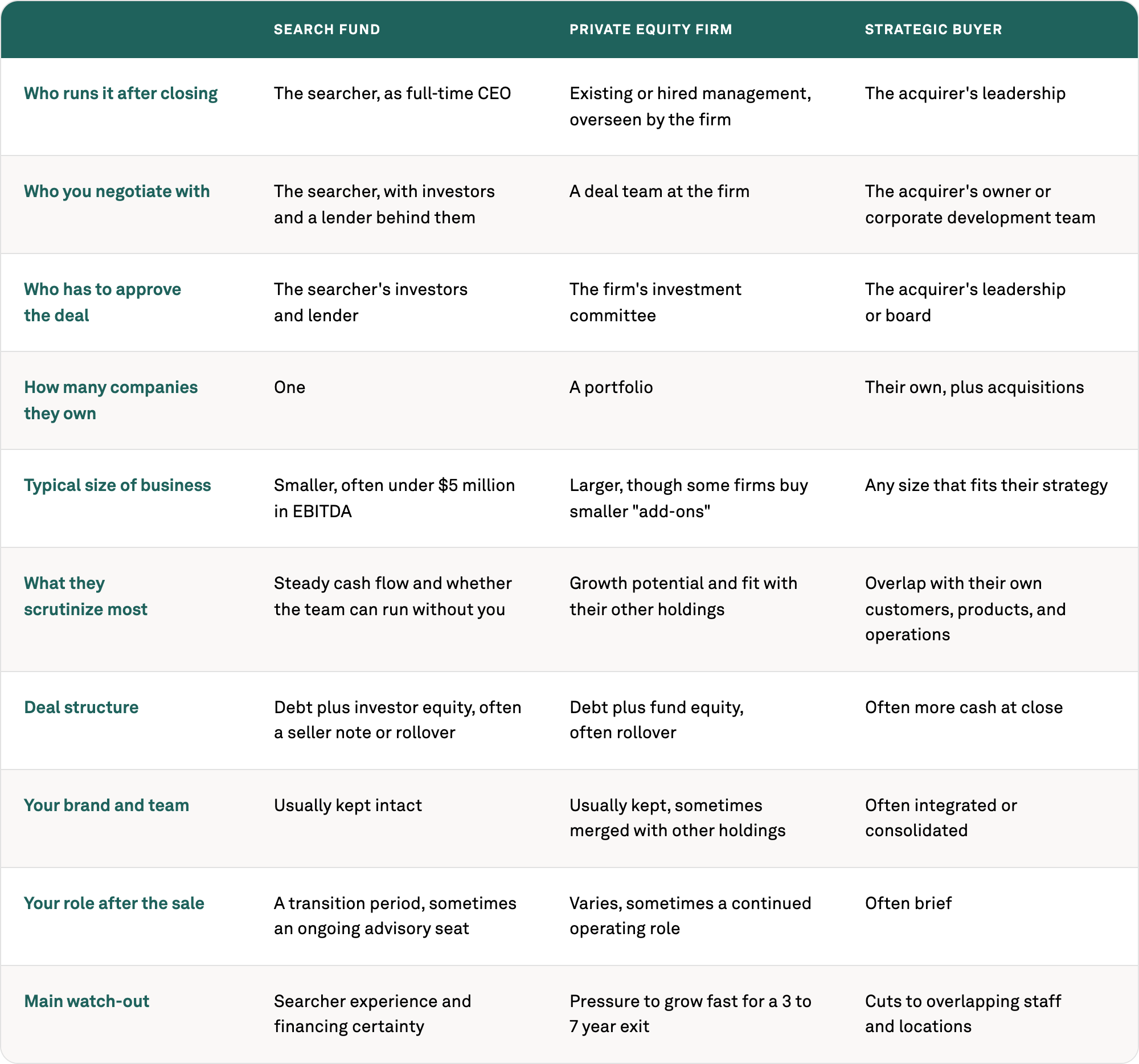
Should You Sell to a Search Fund?
It depends on what you want your exit to look like. Searchers are a strong fit for owners who care about legacy and continuity. They're a weaker fit for owners who want the highest possible cash at close and a clean break.
Why owners choose searchers:
Continuity. One person buys your business and runs it. Your name, your team, and your customer relationships usually stay put.
A successor, not just a buyer. If you've struggled to find someone inside the company to take over, a searcher fills that gap.
Experienced backers. Traditional searchers often bring investors who've funded dozens of these deals and know how to get one across the line.
Upside after the sale. Rolled equity or a seller note lets you share in the business's next chapter.
Why owners may have concerns:
Execution risk. Many searchers have never run a company, and some have never worked in your industry.
Closing certainty. A searcher needs investor and lender approval before closing. Roughly half of recent searchers never complete an acquisition, so an eager first meeting is no guarantee.
Less cash up front. Seller notes and earnouts mean part of your price depends on the business's performance after you leave.
The Bottom Line
A search fund is one person betting their career on one business. For the right owner, that's exactly the buyer you want: someone who chose your company on purpose and plans to show up every day.
If you're a searcher, new on- and off-market deals come to Baton every week. Start browsing now.
If you're an owner, Baton connects you with more than 25,000 vetted buyers, including self-funded searchers. Start with a free valuation built on real comparable transactions so you know what your business is worth before the first offer arrives.
Search Fund FAQs
What Is the Difference Between a Search Fund and Private Equity?
A search fund buys one company and the searcher runs it as CEO. A private equity firm buys many companies, manages them as a portfolio, and relies on hired executives to run each one. Search funds also tend to buy smaller businesses.
How Much Money Do You Need for a Search Fund?
A traditional searcher raises a few hundred thousand dollars from investors to fund the search itself, then raises the acquisition equity once a company is under contract. A self-funded searcher pays search costs personally and usually finances the purchase with an SBA loan plus a down payment.
What Is the Success Rate of Search Funds?
According to Stanford's 2026 study, 58% of search funds since the model began have acquired a company, but the rate is closer to 50% for funds launched between 2021 and 2024. Of those that buy a company, results vary widely.
Are Search Funds Worth It?
For investors, historically yes. Stanford reports an aggregate 33.9% internal rate of return and a 4.75x return on investment as of the end of 2025. For searchers, it's a high-variance bet: about two years of searching with no guarantee of a deal. For owners, it's worth it when you value continuity and a hands-on successor.
How Do Search Fund Entrepreneurs Get Paid?
Searchers draw a modest salary during the search, then a CEO salary after acquiring. Most of their upside comes from an equity stake in the company that vests over time and with performance.
Do I Have to Stay On After Selling to a Searcher?
Usually for a transition period, and the length is negotiable. Because the searcher is often new to your industry, they'll want your help introducing them to customers, suppliers, and key employees.
How Do I Find Search Fund Buyers for My Business?
Searchers find businesses through direct outreach, brokers, and online marketplaces. If you're open to selling, a marketplace like Baton puts your business in front of vetted buyers, including searchers, who sign a single non-disclosure agreement (NDA), and gives you an advisor to help compare offers.