Best Websites to Buy a Business in 2026

Dylan Gans
⋅
10 min read
This article was originally written in September 2025 and has since been updated with new discoveries and research in 2026.
Buying a business starts with finding the right opportunities. But where you search can make a big difference in what you actually find.
Some marketplaces give you thousands of listings but limited financial detail. Others specialize in specific types of businesses, geographies, or buyers. And even when a listing looks promising, getting the information you need to evaluate it can mean another NDA, another data room, and another round of back-and-forth.
That matters in a market where buyers have plenty of businesses to consider. More than 1,500 businesses attracted buyer interest on Baton alone between February and August 2026, but buyer attention is uneven. The challenge isn't finding businesses for sale. It's finding the right ones, getting enough information to evaluate them, and moving quickly when a deal makes sense.
Below, we break down the best websites to buy a business in 2026, what each platform is best suited for, and where to look beyond the major marketplaces.
If you're on the sell side, see our guide to the best websites to sell a small business.
How to Choose a Website to Buy a Business
Before you compare platforms, get clear on your budget, the industries you're targeting, and your timeline. Then evaluate each platform on the following:
Listing quality. Can you see verified financials, like seller's discretionary earnings (SDE) or EBITDA, before you invest hours in a deal? Or just an asking price and a paragraph?
Seller vetting. Are sellers committed and prepared, or can anyone post a listing to "test the waters"?
Access and friction. Do you sign one NDA or a new one for every listing? Is every data room organized differently?
Support. Will someone help you interpret financials, structure an offer, and get through diligence, or are you on your own?
Fit. Does the platform actually carry the type and size of business you want? A marketplace built for $50K content sites won't help you buy a $3M HVAC company.
Quick Picks: Best Websites to Buy a Business by Buyer Type
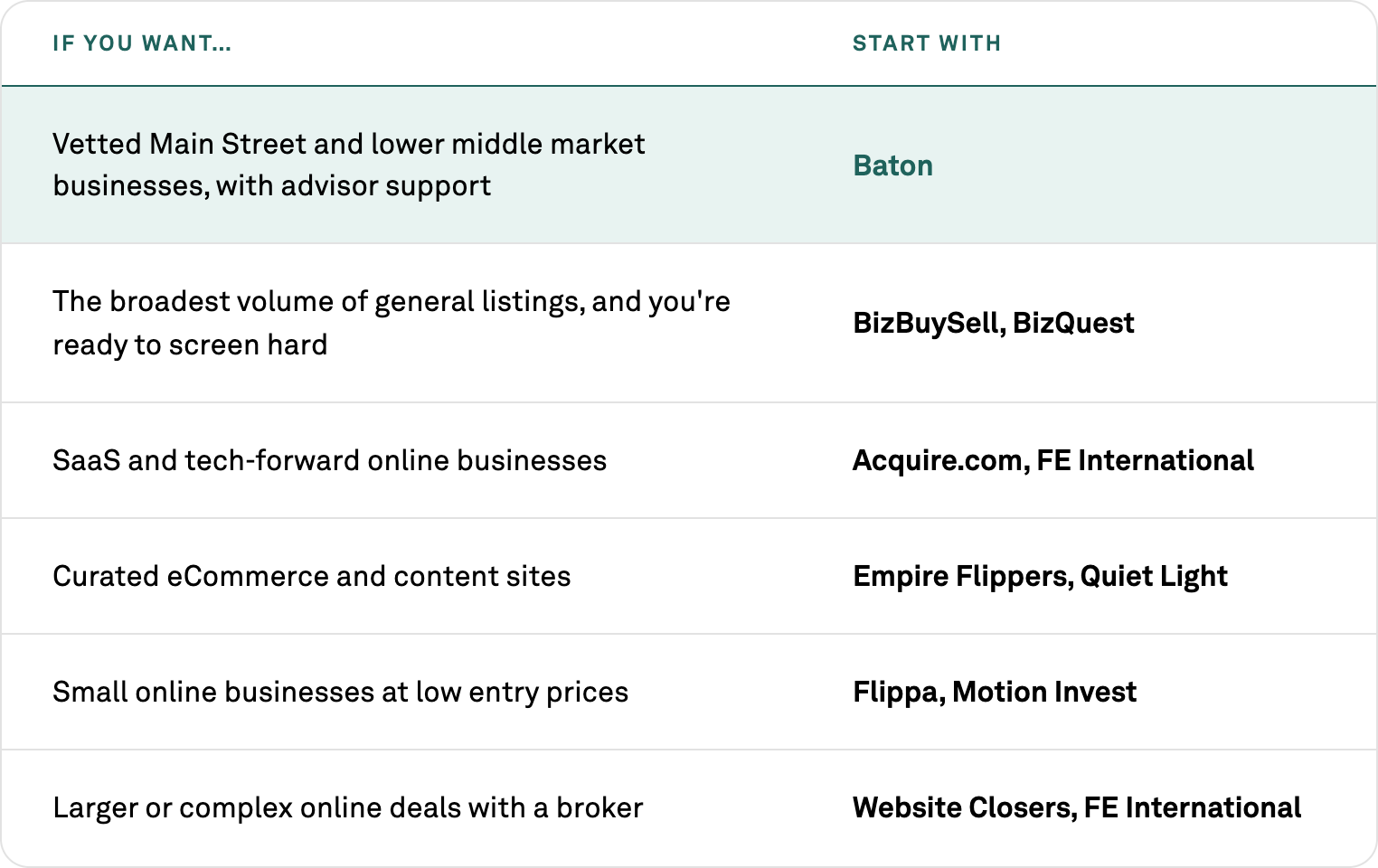
Table matching buyer goals to where to start: Baton for vetted Main Street and lower middle market businesses with advisor support; BizBuySell and BizQuest for the broadest volume of listings; Acquire.com and FE International for SaaS; Empire Flippers and Quiet Light for curated eCommerce and content sites; Flippa and Motion Invest for small online businesses; Website Closers and FE International for larger online deals with a broker.
The Best Websites for Main Street and Lower Middle Market Businesses
These platforms focus on traditional small businesses, like service companies, manufacturers, distributors, healthcare practices, and franchises, typically in the $500K to $10M range.
1. Baton
One note on Baton: This is our own platform, so naturally, we're not a neutral source on this one. We've included it because we think the differences in how marketplaces handle information, access, and the buying process are useful for buyers to understand.
Baton is a data-first marketplace built to make small-business acquisitions easier to evaluate and move forward. Listings include more financial and operational detail upfront, and the platform is designed to give buyers a more consistent process from initial search through diligence.
What buyers get:
One NDA for the whole marketplace. Sign once and access every listing and data room from a single login, instead of repeating the NDA process for each deal.
Standardized, data-rich listings. Key metrics sit directly on the listing page, and serious listings include a consistent data room with financials, tax returns, contracts, and owner interviews. That makes it easier to compare opportunities before spending time on diligence.
Vetted, committed sellers. Sellers go through structured onboarding, Q&A, and owner interviews before a listing goes live. The goal is to put buyers in front of owners who are actively preparing to sell.
Smart search and matching. Describe what you're looking for in plain language, see match scores, and get alerts when new listings fit your criteria. Baton's team can also reach out when a business matches your buy box.
Hands-on advisor support. Baton's M&A advisors help buyers interpret financials, prioritize questions, structure offers, and coordinate diligence and financing. That can be particularly useful for first-time buyers.
Off-market access. Baton also offers off-market businesses for sale that aren't publicly listed.
Best for: Owner-operators, search fund and ETA buyers, and strategic or financial buyers who want more information upfront and a structured path from initial interest to LOI.
Keep in mind: Baton is a curated marketplace, so you'll see fewer listings than on the largest open marketplaces. The tradeoff is a more standardized process and more information available earlier in the search.
2. BizBuySell
BizBuySell is one of the largest and most established marketplaces for businesses for sale in the US. It has listings across nearly every major business category and geography, from restaurants and home services to manufacturing, professional services, franchises, and online businesses. Listings come from both business brokers and individual owners.
What buyers get:
A very large pool of listings. The biggest advantage is breadth. If you're still figuring out your target industry, geography, or price range, there are plenty of businesses to browse.
Detailed search filters. You can filter by asking price, cash flow, revenue, location, industry, and other listing attributes.
Broker and seller contact information. Listings generally give you a direct path to whoever is handling the sale.
Market research tools. BizBuySell also publishes transaction and asking-price data that can help buyers understand pricing across different business categories.
Best for: Buyers who want the broadest possible search and are comfortable doing significant screening themselves.
Keep in mind: BizBuySell is a listing marketplace, not a standardized acquisition process. The amount and quality of financial information can vary considerably from one listing to another. Buyers should expect to request additional information, sign deal-specific NDAs, and conduct their own diligence.
3. BizQuest
BizQuest is another large US marketplace covering a wide range of industries, business sizes, and locations. It is particularly useful for buyers who want to search by geography or explore established franchise opportunities alongside independent businesses.
What buyers get:
Broad industry coverage. Listings range from restaurants and retail to professional services, manufacturing, healthcare, and franchises.
Strong geographic search. Buyers can narrow opportunities by state, city, and region, which is useful for owner-operators looking for businesses they can realistically operate in person.
Franchise listings. BizQuest has a substantial franchise section, making it useful for buyers comparing independent businesses with franchise opportunities.
Broker access. Many listings are represented by brokers, giving buyers a point of contact for questions and additional deal information.
Best for: Buyers focused on a particular geography, especially those considering local businesses or franchises.
Keep in mind: Like BizBuySell, BizQuest is an open marketplace rather than a standardized transaction platform. Listing detail varies, and buyers should expect to do their own work to validate financials, understand seller add-backs, and determine what is actually included in the sale.
4. BusinessesForSale.com
BusinessesForSale.com takes a broader geographic approach than most US-focused marketplaces. It features businesses for sale across the US as well as markets in Europe, Asia, Australia, and other regions.
What buyers get:
International reach. It's useful if you're open to buying outside your home market or simply want to see what businesses are available in other countries.
Wide range of business types. Listings span traditional Main Street businesses, professional services, online businesses, hospitality, manufacturing, and more.
Owner and broker listings. Depending on the market, buyers may interact directly with owners or with intermediaries representing the seller.
Geographic flexibility. Country and regional filters make it relatively easy to explore opportunities outside the US.
Best for: International buyers and buyers whose search isn't limited to one US market.
Keep in mind: Because the marketplace covers many countries and listing sources, the buying process can vary substantially from one opportunity to the next. Financial reporting, deal structures, taxes, regulations, and transaction conventions may also differ by country.
The Best Websites to Buy an Online Business
If you're specifically looking for a website, SaaS company, or eCommerce store, these specialist platforms focus on digital businesses:
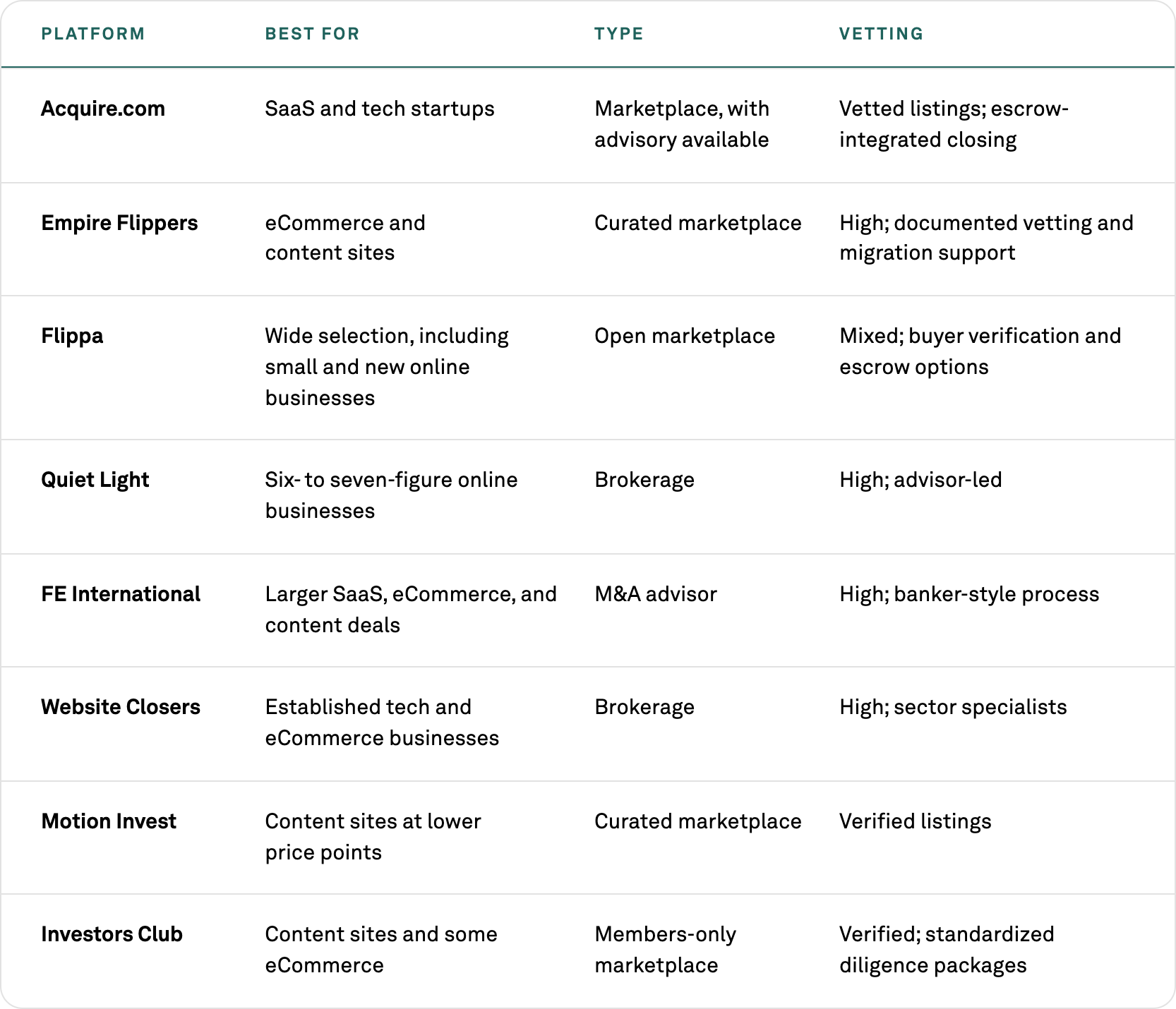
Comparison of online business marketplaces by best use, platform type, and vetting: Acquire.com, Empire Flippers, Flippa, Quiet Light, FE International, Website Closers, Motion Invest, and Investors Club.
For online businesses, verify traffic and revenue at the source. Ask for read-only access to analytics and payment accounts, check dependence on a single platform (like Amazon or Google search), and always close through an escrow service so funds only release when both sides confirm the terms are met.
Beyond Marketplaces: Other Ways to Find a Business to Buy
Many of the best deals never appear on a public listing site. If you're wondering how to find a business to buy, combine marketplaces with these channels:
Off-market platforms. Some marketplaces, including Baton, offer off-market profiles from owners who are exploring a sale quietly.
Business brokers. Local and industry-specialist brokers often have listings before they go public. Tell them your criteria and show you're a serious, qualified buyer.
Direct outreach. Many searchers contact owners of businesses they'd like to buy directly, especially in fragmented industries. It's slower, but it can surface deals with no competition.
Your professional network. CPAs, attorneys, bankers, and SBA lenders often know which clients are thinking about retiring.
Industry associations and conferences. Owners approaching retirement are often active in trade groups.
Search fund and ETA communities. Other buyers can share leads, brokers, and lessons learned.
Red Flags on Business-for-Sale Listings
No financials until after multiple calls, or numbers that change between conversations
An asking price with no explanation of how it was calculated
A seller or broker who won't respond for a week or more after you've shown serious interest
Pressure to skip diligence steps or to wire money outside of escrow
Heavy reliance on one customer, platform, or the owner that isn't disclosed upfront
Final Thoughts: Find Your Next Business With Confidence
The best website to buy a business is the one that helps you spend your time on real opportunities: clear financials, committed sellers, and a process where you always know what comes next.
Baton brings that together in one place, with vetted listings, one NDA for the whole marketplace, standardized data rooms, and M&A advisors who help you move from first look to closing.
Frequently Asked Questions
What is the best website to buy a business?
It depends on what you're buying. For Main Street and lower middle market businesses, Baton offers vetted sellers, standardized data rooms, one NDA for every listing, and advisor support. BizBuySell and BizQuest offer the most volume. For online businesses, Acquire.com, Empire Flippers, and Flippa are popular options.
Where can I find businesses for sale?
Online marketplaces are the easiest place to start. Business brokers, off-market platforms, your professional network (CPAs, attorneys, and lenders), industry associations, and direct outreach to owners can surface deals that never get publicly listed.
What are the best alternatives to BizBuySell?
Popular alternatives include Baton, for vetted listings with standardized financials and advisor support; BizQuest, for regional listings; and BusinessesForSale.com, for international searches. If you're buying an online business, look at Acquire.com, Empire Flippers, and Flippa.
How do I find off-market businesses for sale?
Use platforms that offer off-market profiles, such as Baton's off-market listings. Tell brokers your criteria so they call you first, reach out to owners directly in industries you know, and ask CPAs, lenders, and attorneys to introduce you to owners who are considering a sale.
How much money do I need to buy a small business?
It depends on the price and how you finance it. With an SBA 7(a) loan, buyers generally need to put in at least 10% of the total project cost as equity, and seller financing can sometimes cover part of that. Talk to an SBA lender early to understand what you'll qualify for.