Don’t Overpay for a Business Valuation: 2026 Cost Guide

Chat Joglekar
⋅
11 min read
Average Business Valuation Cost in the U.S. in 2026
The figures below provide a realistic frame of reference when you evaluate proposals, compare your options, and think about overall business valuation services cost:
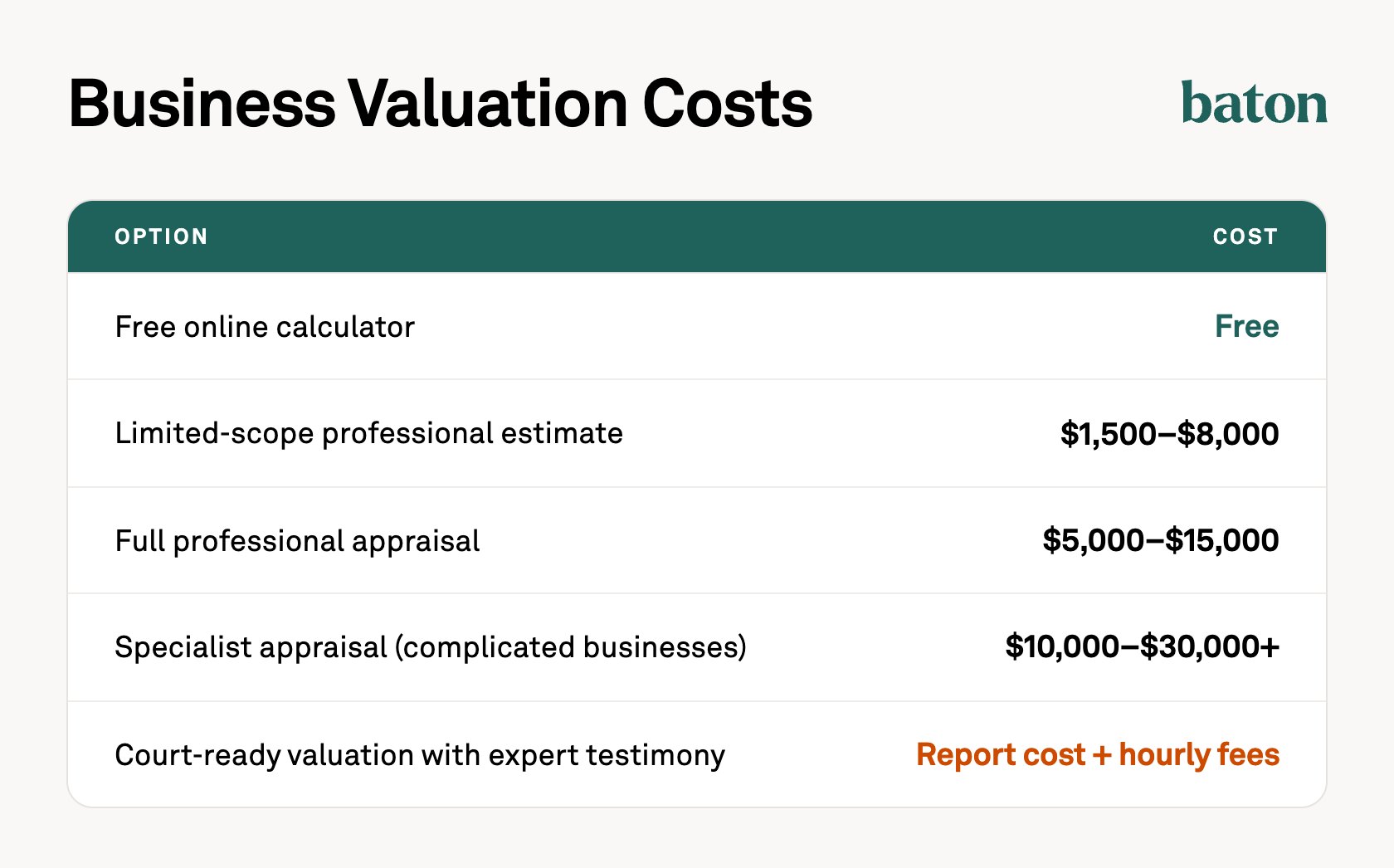
A traditional small business valuation costs thousands of dollars. For owners who need a certified appraisal for legal or transactional purposes, that investment can be worth it. But for the millions of small business owners who simply want to know what they’ve built, and make smarter decisions because of it, the high cost of traditional valuations has been a real barrier.
Our fundamental belief is that every small business owner deserves to know the value of their business, and how it stacks up to competitors, not for thousands of dollars, but for free.
In my role at Baton, I spend a lot of time talking to small business owners and buyers, listening to their feedback, and finding ways to use it to improve our products. One question comes up again and again:
It says it’s ‘free,’ but what’s the catch? A competitor charged me a few thousand dollars for a valuation. Are you trying to sell me something?
As business owners, so much of what we encounter is marketing speak and misaligned incentives. So instead of asking "how much does a valuation cost?", ask "what is a valuation actually worth to me?" Answer that, and you won't buy more than your decision requires.
Below, we break down typical business valuation costs by business size and purpose, how providers structure their pricing, the factors that drive a business appraisal cost up or down, the hidden fees to watch for, and how to decide between a free valuation and a paid certified appraisal.
How much does a business valuation cost?
Ultimately, the cost comes down to the labor behind it: who’s doing the work, how deep the analysis goes, and how defensible the final number has to be. That number further varies by the type of valuation you need. Valuations are priced on labor: the deeper the analysis your situation demands, the more time it takes and the more it costs.
What am I actually paying for?
Many assume a valuation fee buys you a one or two-page document. What you’re actually buying is the work required to make that number defensible. Before a buyer, lender, SBA underwriter, or attorney will take a valuation seriously, someone has to do hours of analysis behind it, and that labor is what shows up in your business appraisal cost. Specifically:
Cleaning up the earnings picture. Small business financials rarely reflect true earning power at face value. Owners pay themselves above or below market, run personal costs through the company, and book one-off windfalls or expenses. Before any math happens, the analyst has to strip all of that out and rebuild a picture of what the business genuinely produces.
Choosing the right approach and defending it. There’s no universal formula. Income-based methods, market comps, and asset-based approaches each tell part of the story, and they suit different businesses differently. Part of the fee covers the judgment call of which methods to use, how heavily to weight each, and the written rationale that will hold up when someone pushes back.
Pricing in risk. Two businesses with identical profits can be worth very different amounts. If half your revenue comes from one customer, or the business can’t run without you, or margins swing year to year, those risks get baked into the multiple or discount rate. Quantifying them responsibly takes real investigation, not a checkbox.
Reading the market around you. Your numbers only mean something in context. The analyst has to research your industry’s trajectory, current demand and pricing dynamics, and what comparable companies are actually selling for, then connect that research back to your specific situation.
Packaging it for the people who’ll scrutinize it. The final step is turning all that analysis into a report an outsider can follow: clear assumptions, supporting exhibits, and a logical path from the raw data to the concluding value. A number without that paper trail won’t survive due diligence.
If a lender or court will review the number, the work is worth every dollar. If you’re just curious, it’s probably more than you need.
What drives your business valuation cost
Six variables account for most of the difference between a $2,500 engagement and a $25,000 one.
1. Quality and completeness of your financial data
Clean, consistent financial statements over several years make the analyst’s job easier. When records are incomplete, mixed with personal expenses, or inconsistent between tax returns and internal reports, more time is needed to normalize the numbers, and time is what you’re billed for.
2. Purpose of the valuation
The reason for the valuation significantly affects the cost of a business appraisal:
Selling the business or M&A: usually requires a more detailed, market-based approach
Tax or legal compliance: must meet strict IRS or legal standards, which increases valuation costs
Internal planning: can be done at a lower price with limited scope
A high-level estimate for internal planning is not the same as a report that will be reviewed by an SBA underwriter, an institutional investor, or opposing counsel. The more critical the decision and the more eyes on the report, the more you’ll pay.
3. Type of valuation report
Calculation of Value: a rough estimate; the lowest business appraisal cost (~$2,000–$5,000)
Summary Report: more detail; mid-range (~$5,000–$15,000)
Comprehensive Report: highly detailed, IRS- and court-compliant (~$15,000–$50,000+)
4. Complexity of your business
A straightforward local business with clean books costs less to value than a company with multiple entities, locations, currencies, or a layered cap table. Consolidating and analyzing those structures requires additional modeling and documentation.
5. Your industry
Specialized and heavily regulated fields (healthcare practices, law firms, SaaS businesses, managed service providers) require deeper research and rely on benchmarks that are harder to source, which is reflected in the pricing.
6. Timeline and urgency
Compressed deadlines mean putting more resources on the engagement to meet the date without sacrificing quality. That extra effort shows up in the fee.
Flat fee vs. hourly: how providers bill
Most providers charge in one of two ways.
Flat-fee pricing
The most common model. You agree on a fixed price for a defined scope before any work starts. For instance, around $2,500 for a basic calculation of value, roughly $7,500 for a standard appraisal, or $15,000 and up for a full report. The appeal is predictability: it’s simple to budget for, and simple to compare one provider’s business valuation services cost against another’s.
Hourly billing
Other appraisers charge by the hour, usually somewhere between $200 and $500. That flexibility cuts both ways. If the project scope grows, so does the invoice, sometimes dramatically. Anyone quoting hourly rates should be willing to put a written cap on the total before you commit.
The better question: how much should I pay for a valuation?
You can look up the national average. You can ask a friend what they paid, or spend an evening on Reddit. All of that tells you whether a quote is fair, but none of it tells you whether the valuation is right for you.
Generic online calculators can’t analyze owner-related adjustments, qualitative risks, or lender expectations in a meaningful way. And on the other end, a $15,000 comprehensive report is unnecessary if you’re just trying to understand where you stand. The right amount to pay depends entirely on what the valuation has to hold up against.
Free online calculators run a handful of inputs, usually revenue, earnings, and industry, through standard multiples and generate a number in seconds. Our own valuation goes further: it’s sector-adjusted and built on real market data, so the ballpark reflects what businesses like yours actually sell for, not a generic formula.
Use it for a pulse check on where your business stands, a reality test against what you assumed the business was worth, or a starting point for planning. What it isn’t is a substitute for a certified appraisal when a lender, the IRS, or a court needs to sign off.
Limited-scope valuations are a step up from a free estimate. Instead of a formula processing whatever you type in, an actual analyst reviews your financials, makes high-level adjustments for things like owner pay and one-time expenses, and gives you a written opinion of value.
The scope is narrower than a full engagement, so fees sit at the bottom of the ranges above. Worth it for decisions you’re making privately, such as early thoughts about a sale, succession planning, weighing whether to grow or exit, where you want professional judgment applied to your actual books, but nobody outside is demanding a certified report.
Full-scope valuations are built for real transactions: buying or selling a company, buying out a partner, or supporting major tax and estate decisions. Expect multiple methodologies, deeper financial work, and a narrative document third parties can rely on. This is the right call when the other side will be doing serious due diligence.
SBA-compliant valuations answer to lenders. Underwriters want to see how the value was derived, why the assumptions hold, and whether the business can carry the loan. That lender-specific structure pushes these engagements into the middle-to-upper part of the market.
M&A and institutional-investor valuations face the toughest audience. Investment committees expect granular cash-flow models, sensitivity testing, credible comps, and honest treatment of downside scenarios, and the price reflects all of it.
Free online calculators
Typical cost: $0
Pros: Fast, easy, no cost
Cons: Very rough estimates, no risk analysis
Best for: Curiosity, back-of-the-envelope
Data-driven free valuations
Typical cost: $0
Pros: Real market data, sector-adjusted, no cost
Cons: Not a certified appraisal for court/IRS use
Best for: Sale planning, benchmarking, tracking value over time
Automated paid tools
Typical cost: $100 – $1,000
Pros: More inputs, some data
Cons: Still generic, limited documentation
Best for: Early planning, internal discussions
Professional valuation expert
Typical cost: $2,500 – $40,000+
Pros: Accurate, defensible, tailored
Cons: Higher upfront cost, more involvement required
Best for: Certain SBA loans, litigation, tax, divorce, disputes
At the end of the day, you will not be the only one looking at the number set. It will have to eventually hold up to buyer and lender scrutiny. Trying to skimp out with a free calculator means you will pay more in time and adjustments later on, rather than getting a defensible number.
How to choose a valuation provider (if you’re paying)
When you do need a certified appraisal, here’s what to look for when comparing business valuation services cost:
Accreditation: look for Certified Valuation Analysts (CVA), ASA, or CBA credentials
Experience: choose someone with industry-specific knowledge
Transparency: you should know exactly what you’re getting for your business valuation cost
Client reviews: ask for references or case studies
Red flags to avoid
They take your books at face value. A provider who skips normalization, leaving owner perks, one-time items, and personal expenses in the numbers, hands you a figure that falls apart the moment a buyer or lender looks closely.
One formula, no explanation. If the entire valuation rests on a single rule-of-thumb multiple, with no reconciliation across income, market, and asset perspectives, it won’t survive basic questioning.
A report no lender would accept. Some cheap valuations arrive as a brief, official-looking letter with no visible reasoning. SBA underwriters and banks routinely reject these.
Final thoughts
The real estate market suffered from the same problem for decades: before the MLS opened up, there was no accessible database of home values, and sellers negotiated blind. Zillow and StreetEasy cracked that open for consumers, for free, and leveled the playing field for homeowners overnight.
That’s what we’re building for small business owners. Baton’s valuations are free because informed owners make better sellers, and better sellers make a healthier marketplace. Our incentives point the same direction as yours: an accurate number, not an inflated one. Your valuation is free today and will always be free.
Frequently asked questions
How much does a business valuation cost for a small business?
Most small businesses (under $1M in revenue) pay $2,500 to $5,000 for a professional valuation. Businesses between $1M and $5M in revenue typically pay $4,000 to $8,000. If you don’t need a certified report for a lender or court, a data-driven free valuation can give you the same directional answer at no cost.
How much does a business appraisal cost for an SBA loan?
SBA loan valuations typically cost $3,000 to $7,500. They must come from a qualified, independent third party and follow lender-ready formatting, which is why they cost more than a basic calculation of value.
Is a business valuation worth the cost?
If you’re facing a legal, tax, or lending requirementm yes. A defensible valuation helps you negotiate a better sale price, attract the right investors, protect your interests in a divorce or partnership dispute, and comply with IRS regulations. In those situations, think of the cost of a business appraisal as an investment, not an expense. If you just want to know what your business is worth, start with a free valuation and only pay when a transaction requires it.
Can I get a business valuation for free?
Yes. Free online calculators give rough ballpark figures, and data-driven platforms like Baton provide sector-adjusted valuations based on real market data at no cost. Free valuations work well for sale planning, benchmarking, and tracking value over timem but they don’t replace a certified appraisal for court, IRS, or certain lending purposes.
How long does a business valuation take?
A calculation of value typically takes 1–2 weeks; a comprehensive certified appraisal takes 4–8 weeks depending on the complexity of your financials. Rush timelines usually carry an additional fee.